Friday, April 20, 2012

The Justice Bell Tour


     On August 18, 1920 the 19th Amendment to the U.S. Constitution was ratified, granting women the right to vote. The amendment stated “the right of citizens of the United States to vote shall not be denied or abridged by the United States or by any State on account of sex. Congress shall have power to enforce this article by appropriate legislation.”  On June 24, 1919 Pennsylvania congress voted to ratify the amendment becoming the 8th state to do so.
     Four years earlier Amendment #1, a women's suffrage referendum, was presented on the November 1915 ballot for approval from the men of Pennsylvania. By this time thirty states of the US had already voted for at least partial rights for women’s suffrage. The Pennsylvania Woman Suffrage Association kicked off a statewide campaign to convince the male voters to vote for the amendment. The “Justice Bell”, an exact bronze replica of the liberty bell was cast with the words "Establish Justice" in the inscription. The 2000-pound bell required a special truck to transport it. At a cost of $2,000., the bell was a gift from Katherine Wentworth Ruschenberger of Strafford, PA. The clapper was muted by chains with the idea that the bell would not ring until women were granted the right to vote.
     The bell began its 5,000-mile tour of the state of Pennsylvania in Bradford County in May of 1915 then continued on through the rest of the 66 counties. It zigzagged through the state ending in Philadelphia in time for the November election. The bell was escorted by a group of speakers and campaign props. Popular items in demand by local suffragettes were “votes for women” fans, buttons, paper napkins, pennants, note-paper, drinking cups, lanterns, flowers, lead pencils, candy, and children's toys. Yellow was the color adopted by the Association and could be seen displayed prominently at the rallies. The bell arrived in Bethlehem on August 29, 1915.
     In addition to the Justice Bell tour the Pennsylvania Woman Suffrage Association organized open-air speeches from automobiles and county fair booths as well as booking halls for their speakers. Bethlehem turned out in record numbers to hear Dr. Anna Shaw speak at the Broad Theater on October 3, 1915.  Dr. Shaw was the first woman ordained by the Methodist Protestant Church. As a minister, she would not perform a marriage ceremony in which the word "obey" would be used. Dr. Shaw noted that none of the marriage ceremonies she officiated ended in divorce. She was national superintendent of franchise of the Women's Christian Temperance Union and president of the National Woman's Suffrage Association. Of her speech in Bethlehem, she was quoted in the October 4, 1915 edition of the Globe Times as stating, “Being human beings women have the qualities that belong to humanity and having them, should have the right of exercising them.”  She went on to say, “A republic is a form of government conducted by representatives of the people. You never read a definition of a republic which granted the right of one half of the people to vote and elect representatives to govern the other half.” Those who attended roundly applauded Dr. Shaw’s speech.

Celebrating ratification of the women's suffrage amendment, Alice Paul, seated second from left, sews the 36th star on a banner, in August of 1920.  The banner flew in front of headquarters of the Women's Party in Washington of which Miss Paul was national chairperson.  The 36th star represented Tennessee, whose ratification completed the number of states needed to put the amendment in the Constitution.  (AP Photo)
     A local suffrage leader, who attended Dr. Shaw’s speech, was Ruth Frick, the great granddaughter of Asa Packer, great-granddaughter of Robert H. Sayre and daughter of Robert P. Linderman. She was the Lehigh County chairman of the Woman Suffrage Party. Frick offered her car for open-air speeches by several visiting women’s suffrage dignitaries. Frick and others went on to form the Allentown Women’s Club.
     On November 2, 1915 Amendment #1 was soundly defeated in Pennsylvania. The 50,000 votes against the referendum were significantly represented in Berks, Lebanon and Lehigh counties. It was widely known that a majority of Pennsylvania German men were against the amendment because various temperance organizations supported the amendment.
     The women’s suffrage campaign turned its focus on a constitutional amendment with support from President Wilson. The House of Representatives and the Senate passed the amendment. When Tennessee became the 36th state to ratify the amendment on August 18, 1920, the amendment passed its final hurdle of obtaining the agreement of three-fourths of the states and became law.

Wednesday, February 29, 2012

Old Videos of the Lehigh Valley

Follow these links to go back in time to see old footage of the Lehigh Valley.


Short vintage film clip shows life in 1950's Lehigh Valley Pennsylvania. Features Bethlehem Steel, Hess's department stores.


This adorable story of 'Pip The Mouse' has been around since 1962. One of only two sets made by Creegan Company of Steubenville Ohio, I believe the only one in operation. Outstanding puppeteer performance, original soundtrack. Can be found at Liberty Bell Museum, Allentown, PA. Original owner Max Hess, read the history of how this puppet became an icon.
http://www.libertybellmuseum.org/museum/pip.html


1950's circa. The Fairgrounds Hotel in Allentown, PA during the 1950's. An italian wedding reception. Backyard scenes during Easter from a farm in nearby Orefield PA.


Relive the bygone era of one of the great landmarks in eastern PA, Hess Department Store by PBS 39.


Check out America's oldest football rivalry as PBS 39 showcases possibly the best known football game in college football, the Lehigh -- Lafayette football game.


Final voicemail left for managers by an Ames VIP the day before the store closed forever. Someone made a video to it.


1914 Trolley from Philadelphia to Allentown


Preview of new (2010) video produced for the Rockhill Trolley Museum from the 1947-1949 films of Gerhard Salomon. This presentation features the Lehigh Valley Transit Company's Easton Line from Allentown to Easton via Bethlehem. Visit http://www.rockhilltrolley.org for ordering information.


Video slideshow of Allentown and Bethlehem Steel set to Billy Joel's Allentown. Long Live Bethlehem Steel; Hail Steel!


Bill McLane "Railroad Memories"
Bill McLane is interviewed by Max Carroll of WNCY-24's Unique New York on February 14, 2000. Bill shares memories of working on the Lehigh Valley Railroad and shows rare 8mm footage he filmed.


A film about the state of Pennsylvania in the 1950s. To license footage from this subject, go to: http://www.travelfilmarchive.com


Friday, February 10, 2012

Lehigh Hook and Ladder Company


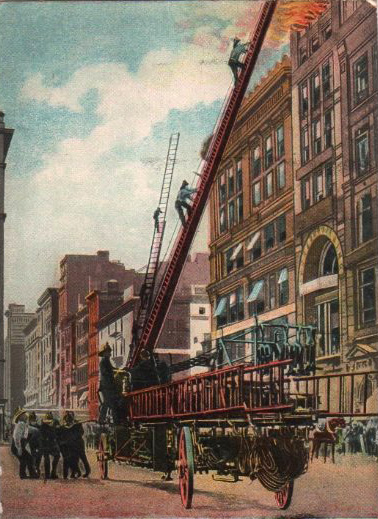
The Grand Opera House and the Union Hall on 4th Street burned to ground in the middle of the night of October 7. 1884. The cause of the fire was never determined. There was no Hook and Ladder apparatus available in South Bethlehem at the time of the fire. The residents of the South Side decided it was time to remedy this problem and organized the Lehigh Hook and Ladder Company on November 24, 1884. They were ready for fire emergencies by December 10, 1884, when they acquired a hand-drawn hook and ladder truck. Temporarily the fire equipment was stored at the stable of H.C. Bachmans First Ward Hotel and then it was moved briefly to Lewis Levy’s store, on Broadway. Finally Bethlehem Borough council built the fire company a permanent fire hall at 217 Broadway in 1885. They remained at that location until the city phased out the company in the early 1970s.

The good citizens who formed the Lehigh Hook and Ladder Company were R.H. Sayre, Jr., President; William H. Rudolph, Vice-president; Milton S. Grim, Secretary; W.A. Wilbur, Treasurer; Frank Wynkoop, Fire Recorder; Milton H. Miller, Frank O. Lear and George O. Weaver, Trustees; Morris H. Schaffer, Foreman; William F. Anderson, Assistant Foreman; Charles H. Groman and Tillermen; Clinton H. Weiss.

The equipment known as a hook was a steel crook at the end of a wooden handle, six to twenty feet long. It was used to rip down ceilings to reach fire areas and to pull down burning structures. Hooks were also used to pull down houses the flames had not yet reached in order to create a fire-break.

In August of 1886, the Company received a horse-drawn hook and ladder wagon. Twelve leather water buckets hung from the bottom of the wagon. On November 5, 1895 Council supplied a new horse-drawn 75-foot Hayes Aerial Extension Ladder Truck. This truck had an aerial ladder that could extend as much as 85 feet in height. Four to six men could fully raise the telescopic ladder in less than 40 seconds by turning a crank. The aerial was mounted on a turntable, so the ladder could be swung around to the desired direction. It seemed that whoever could supply the horses became the driver. L.J. Bachman was the first driver who furnished two horses then Lewis Felker became the driver as he provided three horses. Typically, when a horse drawn wagon or truck reached the fire, the firemen released the horses to get them out of harms way. It was the firehouse dog’s responsibility to guide the horses to a safe place to wait until the fire was out.

The South Bethlehem community showed their support in various ways for the brave men of the Lehigh Hook and Ladder Company. In 1887, the Bethlehem Iron Company presented the Company with a safe. Johnson A. Yerkes, a local artist and member of the Company donated his painting of the burning of the coke works to the firehouse, which he had painted in 1855. The 1854 destruction of the coke works may have been the first recorded fire in South Bethlehem. The painting was displayed in the fire hall until the Company was dissolved. The Kemerer Museum, at 427 N. New Street has the painting in their collection, along with a helmet, badges, and an elaborate 4-by-6-foot wooden frame that holds 54 photographs of members of the Lehigh Hook and Ladder Company in 1887.

In 1891 the borough installed a Gamewell Fire Alarm System. It utilized the South Bethlehem telegraph system to pinpoint the location of a fire alarm. Alarm stations were set up through out South Bethlehem, which could trigger a 2075-pound bell that was hung in the tower of the Liberty Company’s fire hall on Vine Street. The Borough also maintained a supplementary alarm of a large whistle located at the South Bethlehem Brewery. Gamewell still manufactures fire alarm systems today but with more sophisticated technology such as fiber-optic cable.

In 2004 the South Bethlehem Historic Commission approved plans presented by George Kline for the renovation of the old Lehigh Hook & Ladder Company’s 2-½ story building. Kline owned the old fire hall that his company, Bethlehem Sporting Goods, used as a warehouse. With this approval, Kline cleaned and repointed the bricks, restored the windows, replaced the roof and recreated the old fire hall doors. Kline received a $30,000 BEAR grant (Blight Elimination and Abatement Response) and a $60,000 facade loan from the city of Bethlehem to complete the work on the 8,000-square-foot building. Kline did such a fine job at restoring the old fire hall that as you pass the building you expect the bell to ring and the doors to swing open for a horse powered hook and ladder wagon to exit the building. You look for fire fighters with axes and bullhorn-like trumpets all wearing wool Civil War-style uniforms with red wool shirts, rubber slickers, leather helmets and knee-high leather boots. The building is now the site of The Firehouse, a bar and restaurant.

Friday, September 30, 2011

History of Education in Northampton County


Engraving of Pennsylvania Governor George Wolf.

     Before 1834, when the “Free School Act” was passed in Pennsylvania, church schools commonly provided education. When settlers formed a community large enough to support the building a church, a school was usually built next. The curriculum for these schools included reading, writing, spelling, arithmetic and religion. If parents could not afford the subscription cost or did not approve of the religious instructions, their children went without a school education.
     The Bethlehem Moravians arrived in America as an organized community. Separately, a girls and boys schools were opened in 1742. The female seminary was organized in 1785, which was the first secondary school for girls, in the United States.
     The Free School Act put the Moravian Church leaders in a difficult position. Bethlehem already had strong educational institutions when the act was passed. To accommodate the new act the Moravian day schools, separate schools for boys and girls, were converted into public schools. A public school board was elected with the same individuals that served on the previous board for the Moravian private schools. The Bethlehem Area School District as an entity was approved by the state legislature in 1836. This collaboration came to an end in 1844 when there were enough non-Moravian children in Bethlehem, whose parents sought secular instruction.
     In 1854, the Pennsylvania Legislature passed an act requiring the professional supervision of all public schools. The county superintendent was elected for three-year terms by the school boards of directors, within the county. Every June, all the county superintendents submitted a report for the school year. These reports were published in a hardbound book. Today, you can find this books in the special history collections of the Bethlehem Area Library and Easton Public Library.
     Valentine Hilburn was elected as the first Northampton County Superintendent in 1854. Hilburn was very outspoken which made him unpopular with teachers and school boards. He wrote in his Superintendent Report of 1855 that too many teachers in their dry presentation of information were dull and heavy and discouraging to students. He stated that most school board directors refused to do their job and were corrupt by their frequent requests for funds from the district treasurer. He instituted exams for teacher certifications for the first time in the county. During Hilburn’s term more than half of the students in the county did not speak, read or write in English. German was the primary language in use. Teaching English to the county’s students became a top priority for Hilburn.
     The next superintendent to serve Northampton County was Abraham Kind. He served two terms (1860-1866). The Civil War drained the county of seventy male teachers. Superintendent Kind pushed for female replacements. He said, “Their success and usefulness was equal to that of the best male teachers.”
     In 1875, Superintendent of Public Instruction J. P. Wickersham reported that male teachers were receiving an average of $6.98 more a month in salary than their female counterparts, who received $34.09 a month. All the teachers had received a decrease in salary from the previous year of $1.83. The average length of the school term, through the state was 6.85 months. The percentage of registered students who attended school was 62%. The state paid about 12% of the educational costs of the districts. Wickersham deliberated over the role of the bible in public schools. He acknowledged that it was unfair to use public money for sectarian purposes. His solution was, “the Bible-reading should take place at the end of the day, neither loss of time nor disorder need result from a part of the pupils quietly leaving the school room at a given signal.”
    The Northampton County superintendent, B.F. Raesly, in 1875, reported that no new schoolhouses in the county were built during the past year. He stated that all the schoolhouses were equipped with out-houses and the teachers were responsible for their cleanliness. The most up-to-date schools had factory made desks (as opposed to homemade desks and benches), along with blackboards, globes, maps and charts. Parents were responsible for purchasing their children’s schoolbooks. Raesly had high praise for the South Bethlehem High School, one of only two high schools in the county. He commended the excellent condition of the room where the high school was held, as it was furnished with Bancroft seats and desks. Alexander C. La Barre of Bethlehem assisted in preparing the program for the Northampton County Teachers Institute. La Barre was the Supervising Principal of the Bethlehem School District.
model of schoolhouse
     The Centennial International Exhibition of 1876 was held in Philadelphia. In the Pennsylvania Hall, exhibits were selected to impress domestic and foreign visitors. A model of the ideal Pennsylvania schoolhouse caused a stir. It represented a 22 X 34 foot structure, which received light through six windows. A cellar wood or coal stove heated the building from the basement. The large platform in front of the building was built at a height of the floor in the average horse driven carriage. A person could step easily from a carriage onto the platform in front of the school. The teacher’s desk sat on an elevated platform. The estimate for building the school was $1,500. The model was a hit with foreign visitors. Japanese officials offered to purchase the model as they were so taken with it.
     Beginning in 1883, Bethlehem public education was under the direction of its own district superintendent, George H. Desh. The school districts of South Bethlehem and West Bethlehem continued under the supervision of the county superintendent. In 1888, Oren R. Wilt was elected as the first district superintendent of South Bethlehem.
Lutz-Franklin Schoolhouse, built in 1880, in Lower Saucon Township.
     As the population grew and school districts consolidated, school districts elected their own superintendents. The Edmonds Act of 1921 ended the county superintendents' role in certification of teachers. In 1969, the name of the Department of Public Instruction was changed to the Department of Education, with the title of Superintendent of Public Instruction changed to the Secretary of Education.

Sunday, June 12, 2011

Dinner=cans of beef or pork and bags of dried beans.


Thirty-five years ago, as the year 1976 began, the Globe Times reported that amendments to the Food Stamp Act of 1964 were about to go into effect in Pennsylvania. Families receiving food stamps no longer had to purchase a portion of the food stamps, which on average required paying for half the food stamps allocated.  Also the stamps were no longer tied to food surpluses. In 1976 one in every fourteen Americans used food stamps. To be eligible the maximum income a family four could have was $542 a month or $6,540 a year. At or below this income level the family would receive $192 a month in food stamps. Therefore a family with income of $542 a month paid $96 for their $192 worth of food stamps.

     During the Great Depression, the increase in unemployed workers resulted in both a surplus of food and larger number of hungry Americans. As people were starving, farmers were burning their surplus corn for fuel. In 1933 the U.S. government found a way to pay farmers for their surplus food then transport the food to the families that needed it. This was a revolutionary idea, as never before did the Federal Government offered food to the poor. Up until this point local communities were responsible for taking care of the less fortunate.  

     The agency, Federal Surplus Relief Corporation (FSRC) was created to administer the new program.  The effort gave much needed assistance to those citizens who needed it but there were problems. People had to walk miles to the closest food site and wait hours for the truck to arrive with one-pound cans of beef or pork, bags of dried beans, flour, cornmeal and occasionally butter and fresh fruit. Garments were also provided, manufactured by the WPA. The food allotments arrived monthly and consisted of the food that happened to be in surplus at the time. Supply was not guided by what was good nutritionally. The creation of a food stamp program in 1939 corrected many of these problems.  One could use food stamps at the local grocery store to purchase food items and government surplus foods.

     Today the food stamp program is called SNAP, or Supplemental Nutrition Assistance Program. Eligible individuals or families are given an electronic benefits card that works like a debit card that you use at grocery stores. Your food stamp benefits are loaded onto your card depending on your benefits, which can range from $2 to over $1502 a month. To receive food stamps you need to meet requirements such as having less than $5,000 in assets. A family of four cannot earn more than $2,297 a month. That family would receive $668 a month for food.

     According to the Community Action Committee of the Lehigh Valley, in 2009, there was a 40% increase in use of food stamps by the residents of Northampton County and a 23% increase in Lehigh County. In 2010 12% of the population in Lehigh County received food stamps and 9.2% in Northampton County. This is a direct result of more people suffering from unemployment. In Northampton County unemployment rose 63% affecting 9.0% of the residents and in Lehigh County it rose 57% leaving 9.2% out of work in 2010. Second Harvest formed a partnership with Bethlehem food banks such as New Bethany Ministries, Holy Bethlel Pentecostal, Concordia Lutheran, Trinity Episcopal, Moravian Food Bank and many others to feed thousands of our neighbors each day.  The Animal Food Bank Services in Hellertown takes care of the pets during hard times for their owners.

You can apply for SNAP benefits on-line at: 
www.humanservices.state.pa.us/Compass.Web/CMHOM.aspx 
or in person at (Lehigh County) Lehigh County Assistance Office, 101 South 7th Street, Allentown, or (Northampton County) Northampton County Assistance Office, 201 Larry Holmes Drive, Easton.

Sunday, May 22, 2011

Broughal School, Gone But Still Missed


     The South Bethlehem School Board established their first public high school, in 1874, in the Penrose School on Vine St. The only other high school in Northampton County, at the time, was located in Easton. Since 1874, the population of the borough grew rapidly.  In 1890, South Bethlehem’s population of 10,386 out did the population of Bethlehem proper. The 1910 census, recorded that the population had grown to more than 20,000. Over a third of the new residents were first generation Americans, immigrants from Europe and Eastern Europe. They sought a better life for their children, which included a good education.
New Broughal School being built as demolition proceeds on old Broughal.
     By the time of the celebration of their Semi-Centennial in 1915, the Borough of South Bethlehem was large enough to be a third-class city. What better way to show their pride than to invest in the future? The school board commissioned the noted architect, A.W. Leh to design a large “state of the art” high school. The borough was so proud of Leh’s architectural drawings that an image of the proposed high school was placed in their Semi-Centennial booklet.
     A.W. Leh designed a four story, 114,000 sq.ft. building in the Italian Renaissance design. It was built (1915-1916) on 4.2 acres on the corner of Brodhead St. and Packer Ave. The floors were laid with Terrazzo tiles. It had a pit-type gymnasium with a capacity for 500 spectators. The first floor, center-of-building, auditorium had a seating capacity of 1,300. The auditorium with balcony was known for its excellent acoustics. Lehigh University ran a jazz series there for several years, taking advantage of the near perfect acoustics. The series included performers; Wynton Marsalis Quartet (1985); Sonny Rollins (1990): Bela Fleck (1994); Tito Puente (1995) and Al Di Meola (1996.)
Broughal School in 1949.
     There were a few unforeseen glitches to the opening of the South Bethlehem High School. With the outbreak of World War I, the allied nations ordered large amounts of goods from the U.S. In the year 1916, before the U.S. joined the war, rail ton-miles increased 32 percent. Shortages were felt nation-wide and delayed the delivery of equipment for the gym and cafeteria of the new school. The U.S. finally entered WWI on April 6, 1917, after Germany sunk seven U.S. merchant ships.
     Another problem occurred in the summer of 1916. A Polio epidemic (known as Infant Paralysis) broke-out across the United States with 27,363 cases reported. Polio was responsible for killing or handicapping more children than any other known disease. Parents were terrified of the disease, until Jonas Salk, from the University of Pittsburgh, used the dead virus as a vaccine successfully in 1955.
Broughal School in 1952.
     South Bethlehem had several cases of Polio. There was a borough wide ban of any kind of public meetings including attending movies, school and places of worship. South Bethlehem lifted the ban on Friday, September 29, 1916. A.W. Leh, architect of the grand new high school, met with the South Bethlehem School Board at the school, on Tuesday, 10/3/1916, to sign off on the project. Leh closely supervised the building of school, one of his greatest achievements. The high school opened that week with Peter J. Hall as the principal. The curriculum included three tracks; classical, scientific and commercial. The total student population in South Bethlehem that year was 2,000.
     At the beginning of the next school year, the high school was presented a flag from the GAR post, Robert Oldham Post No. 527, on September 10, 1917, in a ceremony that included a parade, the Steel Band and several speeches. The Globe wrote about the event, “It was furthermore fitting that the first public meeting held in the handsome and spacious high school auditorium was one in which love of country was the ruling spirit.” The high school’s unique and exquisite auditorium comfortably sat 1000 students that day.
1920 postcard of Broughal.
     The citizens of Bethlehem and South Bethlehem voted to consolidate their governments on July 10,1917. An election for the new city government representatives were held on November 6, 1917, with Archibald Johnson elected as the first mayor. The combined Bethlehems’ population had jumped 65 percent, from 32,810 in 1910 to 50,538 in 1920. In August of 1917, Northampton County Judge, Russell C. Stewart, selected the new school board of nine members for the consolidated city.
     Each new Bethlehem superintendent has had their own ideas about how the school would serve the students. With the building of Liberty High School in 1922, the school became South Bethlehem Junior High. Its name was changed to Broughal Junior High in 1933, in honor of Lawrence Broughal, a former school board member. A 1937 study of the Bethlehem school district reported that Broughal served as a junior high school (7-10) and as a trade and industrial high school (7-12). An addition of 10,000 sq. ft., was added in 1961.
     In 1992, the school celebrated its 75th anniversary. For the diamond jubilee, the school used the motto, "75 Filled with Pride.” The students celebrated with a day of singing songs, meeting alumni and listening to Principal Joseph Petraglia tell the history of the school.
A.W. Leh's drawing of Broughal.
     In 2005, the Bethlehem Area School District, announced plans to build a new middle school for the students of Broughal. Their first idea was to swap the 1916 building for a lot of land on Mountain Top Campus of Lehigh University. The parents of the Broughal students requested that the middle school remain within their neighborhood. In 2009, a new middle school was completed on the lot along side the old school, making the 2008/2009 school year the last year the 94 year old school served the students. At the writing of this article the building still stands. B.A.S.D. plans to demolish the school within days and replace it with a playing field. The Friends of Broughal formed in 2005 to advocate the preservation of the building. Members of the group have faithfully attended school board meetings, city council meetings, written letters to Bethlehem representatives and reached out to anyone who could help to save the beautiful landmark. Christine Ussler, Bethlehem Historic Architect, applied for the eligibility of the building on the National List of Historic Places. She received a letter on April 4, 2005, from the Pennsylvania Historic and Museum Commission approving Broughal’s status of eligibility. In February of 2007, Senator Boscola and Representatives Freeman, Samuelson and Brennan, in a letter to the Bethlehem Area School Board, urged them to consider adaptive reuse of historic Broughal School.
     The elegant building will be greatly missed in the streetscape of South Bethlehem. It was an important part of a group of A.W. Leh buildings that represent the best of South Bethlehem architecture.
A. W. Leh


Local preservationists try to save the Broughal Building. Their signs "This place matters!" fell on deaf ears.
Enhanced by Zemanta

Sunday, April 24, 2011

The Uncooperative Lehigh River


     As the sun was setting on Bethlehem, on August 9, 1814, a crudely built ship, called an ark, was floating by on the Lehigh River. Its cargo would bring Bethlehem into the industrial age. The ark contained twenty-four tons of “black diamonds” or anthracite coal from the Room Run Mine. The ark was sixty-five feet in length and fourteen feet in width and built with hemlock wood. It began its journey at the landings at Lausanne with a crew of six men. Within a quarter mile the ark collided with a slate ledge that caused a gash its side. The crew ripped off their clothing and successfully plugged the hole. The ark stayed afloat all the way to its destination of Philadelphia, five days later.
     The Lenni Lenape were the first to discover the coal and spoke of it to the early settlers. Philip Ginter may have heard these rumors so when he stumbled upon some black rocks, in 1791, while hunting on the summit of the Sharp Mountain, he took them home for further examination. Ginter had migrated to the Mahoning region in the 1770s. He was a miller, farmer and landowner of 300 acres. It is believed that Ginter took a piece of this coal to the local blacksmith, Joe Neyer, who was able to ignite the rock, confirming it was coal. Next, Ginter gave samples of the coal to Colonel Jacob Weis who was living in the area of Weissport, formally New Gnaddenhuetten or Fort Allen.
     Weiss had served as the assistant deputy quartermaster-general at Easton (1780-1783.) Upon retirement in 1783, Weis purchased 700 acres, which included the former Fort Allen, from the Moravian Brethrens and moved his family to that location. He started a lumber business and farm. Weis took the coal to Philadelphia to seek the advice of his cousin, Michael Hillegas, United States Treasurer during the Revolutionary War, Charles Cist, a printer and his brother-in-law, John Nicholson, the Comptroller General of Pennsylvania. Cist was able to verify that the stone was anthracite coal.  With this discovery they decided to form the Lehigh Coal Mine Company in 1792. Weiss offered Ginter assistance in securing a land warrant in exchange for pointing out the spot where he found the coal.
     At first the company’s plan seemed easily accomplished. They needed to find coal deposits, purchase the property containing the deposits, improve the Lehigh River so transportation of the coal by boat would be unimpeded and develop a market for the coal. Every part of this plan proved difficult. Weiss took charge of purchasing 10,000 acres of coal rich land. As he attempted to buy land, counter claims would surface. Weiss eventually sorted out ownership with the company purchasing the land between Mauch Chunk and Tamaqua, along the Lehigh River. The idea of mining coal from shallow pits was abandoned for digging mineshafts at the Room Run Mine near Nesquehoning. This mine was closer to the river therefore reducing the cost of transporting it. Several attempts to clear the Lehigh River for transportation of the coal failed. In 1798, a separate company was organized to deal specifically with this task, the Lehigh Navigation Company.
     The War of 1812 raised the cost of coal and limited its availability through the British blockade of Chesapeake and Delaware bays. This inspired a new attempt of transporting coal from the Lehigh Coal Mine Company down the Lehigh River to the Philadelphia market. The Lehigh Coal Mine Company began leasing their mines to other enterprising men hoping to increase the value of their mines. Some of the original investors, Hillegas, Cist and Nicholson, had passed away. The next generation (Jacob Weiss, Isaac Abel Chapman, Jacob Cist, Charles Miner, and John Robinson) took their chances with the mining and selling of anthracite. Arks were produced at Jacob Weiss’ sawmill at Lausanne. They were sixty-five feet long by fourteen to sixteen feet wide. Each ark could carry from twenty to thirty tons of coal. A pilot who navigated with a pole controlled the ark.
     Josiah White and Erskine Hazard purchased a cartload of the coal that was piled on the ark that passed through Bethlehem in 1814. They wanted to investigate its usefulness for heating the furnace at their mill, the Fairmount Nail and Wire Works, at the Falls of the Schuylkill (northwest of Philadelphia). They experimented with lighting the coal for several hours but soon gave up. They shut the furnace door and left the mill, greatly discouraged. One of the mill workers realized that he had left his jacket. He returned to the mill thirty minutes later to find the furnace to be red hot. The closed furnace door increased the flow of oxygen and facilitated the combustion. White and Hazard saw the great potential of anthracite. Their involvement in the anthracite mining industry solved many of the problems encountered by the Lehigh Coal Mine Company.

Wednesday, April 13, 2011

All Married Female Teachers Lose Jobs


1941 photo of married teachers from Liberty High School.
     The deadline of July 15, 1940, set by the Bethlehem School Board, came and went with no response from the district’s 33 married women teachers. Over a year before, at the June 29, 1939 school board meeting, the board voted 8 to 1 to request the resignations of all the married female teachers of the district. George B. Curtis, head of the board’s administration committee, made the motion. Only one board member, Dr. Frederick F. Bruch, a local dentist, opposed it. William J. Morgan, a Bethlehem Steel employee, was board president. Clifford F. Frey, school district business manager, reported to the board that he had not received one resignation by the dead-line.
     After the 33 women teachers received written notice to resign, they banded together to refuse the ouster. They hired an attorney and informed the school board that they could not be removed simply because they were married. They felt that board’s order was unconstitutional.  The women teachers warned that if the board followed through on their removal they would fight it until it reached the highest court in the state.
     The inspiration behind the board’s decision was to save money. The women teachers would be replaced by "applicants at a beginning salary rate." This, Curtis said, "would result in a saving of $24,700 the first year and eventually would reduce "the tax burden generally."
     Northampton County Superintendent of Schools, George A. Grim noted that the Great Depression had a terrible impact on Northampton County schools, especially in Bethlehem. Bethlehem had the lowest allocation of text books per students in the county. Between 1929 and 1939, there only was only a one percent increase in new students.
    The Bethlehem School Board of the 1930s and early 1940s was a fiscally conservative and autocratic board. A commission was formed in 1937 to study the problems of the district. It was headed by William E. Arnold of the University of Pennsylvania. The committee’s conclusions were presented in a 328 page book. The committee observed that the board gave very little authority to the superintendent of Bethlehem schools, W. H. Weiss. They commented that there was far too much fighting amongst board members and that the curriculum was badly in need of updating. This was an evaluation of the same board that decided for economic reasons to replace all the married women teachers. In 1945, a Citizen’s Committee was formed which successfully instated four new board members, including the first woman, Irma MacLellan.
     Before the Civil War, Northampton County schools employed mostly male teachers. Northampton County Superintendent Abraham Kind reported in 1865 that at least 70 of his male teachers had joined the army. Kind encouraged the employment of women teachers and remarked “Their success and usefulness was equal to that of the best male teachers.”
     In the late 1930s, several bills were introduced to the Pennsylvania House of Representatives to give school boards the right to fire female teachers on the basis of marital status. None were successfully passed. The teacher tenure law passed in 1937 did not mention marital status as a condition of tenure. The law stated that a teacher must serve a three year probationary period before being awarded tenure or a permanent position. The Bethlehem School Board thought that the Pennsylvania School code gave them the power to order the resignations. The code stated, “The school board in every school district in the state may adopt and enforce such reasonable rules and regulations as it may deem necessary and proper regarding the management of its school affairs, and the conduct and deportment of all superintendents, teachers and other appointees or employees during the time they are engaged in their duties to the district.”
     The Bethlehem board’s decision of a marriage ban was reported in newspapers across the state. The board members did not make themselves available for interviews from reporters regarding their controversial ruling. We can assume the board did not follow through on their edict as the subsequent district yearbooks prominently displayed pictures of married female teachers. The priorities of Bethlehem soon were more concerned with national preparedness programs in the early 1940s. Again, a war drained the community of working men, resulting in a teacher shortage. This eased up the prejudices regarding married female teachers. Nationally the employment of married women rose from 26 percent in 1930 to 47 percent in 1940. After the 1940s, marriage bars for female teachers were unheard of.

Friday, March 4, 2011

Great White Hurricane of 1888


     The residents of Bethlehem woke up on March 12, 1888 to find the “Great White Hurricane” at their doors. They may have seen more snow in previous storms, but the combination of the 20-foot snowdrifts, the 50 miles per hour winds and zero degree temperature made for one of the worst blizzards in U.S. history. Bethlehem was completely cut off from her neighbors. The telegraph, telephone and electrical wires were down and could not be repaired because of the dangerous winds. A repairman attempted to climb a forty-foot telegraph pole, on Market Street, only to be blown off the pole as he reached the top. Fortunately he was able to grab a hold of a pin, embedded in the pole, and was soon rescued by his fellow workers. The downed wires meant no communication in or out of town and no electric lights.  Hugh snow drifts closed railroad tracks and roads. Transportation by trolleys, wagons and horses was also not possible due to weather conditions. One could not walk more than a few feet because of the snowdrifts, stinging cold winds and fear of frostbite. The wind shook the houses of Bethlehem for two days. The streets were deserted and all business stopped. Trains that usually brought mail, newspapers, or passengers did not arrive in Bethlehem. Travelers planning to leave town had to stay put. The Eagle Hotel was filled with travelers waiting to leave. Trains were stuck and isolated on tracks in the surrounding country. Conductors learned the hard way that attempts to force the trains through the drifts resulted in derailments. Most farmers could not make it into town to sell their milk and produce. Customers in a panic to buy up supplies met the one or two who did make into town.
     C.H. Linderman’s experience was typical of those who were traveling by train during the storm. Linderman, accompanied by his daughter, was traveling by train to Bethlehem from Reading. Their train only made it as far as Lyon’s Station where it remained snow bound for 17 hours. Lindermen and the rest of the passengers on the train were without food or heat, while they waited to be rescued. The train swayed back and forth as the winds swirled around it. The passengers could do nothing but watch the snow pile up higher than the train windows.
     It wasn’t until five days later that train tracks and the main roads were finally opened. The only method of removing snow was by manpower with picks and shovels. The Lehigh and Lackawanna Railroad and the Pennsylvania and Reading Railroad hired hundreds of men to dig out its snow bound trains. Even as trains were beginning to run to and from Bethlehem, many roads were still closed. Center Street, north of Geopp and Monocacy Street, north of Fairview, were impassable. A mile long, ten-foot drift closed Freemansburg Road. Fourteen-foot drifts were reported on Easton, Bath, Nazareth, and Catasauqua Roads. During the storm, firemen worried about fires igniting from the downed electrical wires. If a fire occurred they were helpless to put it out as neither man nor horse could tolerate the weather. Also the water supply was frozen. It was very fortunate that no fires were reported in Bethlehem.
     Other cities did not fare as well as Bethlehem during the “Great White Hurricane.” The East Coast, from the Chesapeake Bay to Maine, suffered fire damage of $25 million dollars worth of property. Four hundred people were killed, two hundred in New York City, alone. Two hundred ships were lost at sea. In Connecticut and central Massachusetts, 50 inches of snow fell as the winds piled up 50-foot drifts.
     The National Weather Service defines a blizzard as a storm with winds of more than 35 miles an hour and snow that limits visibility to 500 feet or less. A severe blizzard is defined as having winds exceeding 45 miles an hour, visibility of a quarter mile or less, and temperatures of 10 degrees Fahrenheit or lower. This was a severe blizzard.
     Early in the morning of March 11th, a fierce hurricane developed in the Gulf Stream along the west coast of Florida. The hurricane moved north up the east coast and was met by an area of high pressure traveling south from Newfoundland. The two weather systems collided and stalled for almost two days, west of Nantucket Island. Although the U.S. Congress created the National Weather Service in 1870, it wasn’t until weather satellites were launched in the 1960s-70s that we could depend upon accurate warnings of storms. The few days before the 1888 storm were mild and the citizens of Bethlehem were probably thinking of the early arrival of warm spring days. No one could imagine that a devastating blizzard was coming his or her way.
     As the northeast recovered from the “Great White Hurricane” citizens called for more efficient methods of dealing with snow removal. Cities began burying communication wires underground. Boston and New York created subways. Snow removal became a well-planned effort as soon as the first snowflakes fell.
Enhanced by Zemanta

Sunday, January 16, 2011

End of Prohibition, Beginning of PA State Stores


Bethlehem home of master brewer Johann Sebastian Goundie.
On January 2, 1934, the state store system for selling liquor to Pennsylvania residents went into effect. Three hundred state stores were authorized to sell liquor throughout the state by a three person Liquor Control Board. The “dry” or pro-prohibition Pennsylvania Governor, Gifford Pinchot, saw prohibition coming to an end so he pushed through the legislation of a state store system. Prohibition, which banned the manufacture, sale, transport and consumption of alcohol, went into effect on January 16, 1920 as the Eighteenth Amendment to the U. S. Constitution. Over the next thirteen years the amendment became unpopular with the American people. To appeal prohibition, the U.S. Congress chose the route of state conventions to vote on ratification of the Twenty-first Amendment. The Pennsylvania state convention voted in favor of the appeal on December 5, 1933. Of the thirty-nine states only South Carolina voted against ending prohibition. To appease temperance organizations the amendment allowed for states to control alcohol sales within their boundaries.


      Since Gov. Pinchot’s time, a few Pennsylvania governors have attempted to end the state business of selling liquor. In 1974, Gov. Milton Shapp believed that the switch to privately-owned liquor stores would cut operating costs of the state Liquor Control Board and would provide more revenue for the state. He thought this change would make more brands available at lower prices and increase the number of liquor stores. In 1972, the Liquor Control Board commissioned a study to be done by a Philadelphia accounting firm. They found Pennsylvania was selling far less liquor per person than the neighboring states of Delaware, Maryland, New Jersey and New York where liquor outlets are privately owned and operated. Customers in these states paid less than they did in Pennsylvania.


      In 1981 Gov. Dick Thornburgh was also unable to convince the Pennsylvania Senate to consider a bill that would have allowed the privatization of the state liquor stores. Thornburgh blamed the unions for preventing the bill’s passage. Employees of the state stores must take civil service exams to qualify for employment. Depending on their position, they are represented by the unions of United Food and Commercial Workers Union (UFCW), the Independent State Store Union and the American Federation of State, County and Municipal Employees.


      In 1997 Gov. Tom Ridge also failed to privatize the state liquor stores, during his terms of office. His plan was opposed by MADD (Mothers Against Drunk Drivers) and the state Council of Churches.


      The Moravians, who settled Bethlehem, permitted the consumption of alcohol amongst its members but encouraged moderation. Their “Community Ordinances” written in 1762 warned members to avoid excess drinking. The first tavern of the Lehigh Valley was Bethlehem's Crown Inn. Founded in 1745, it became so popular that the Moravians soon saw the need to build a new tavern. The Sun Inn, built in 1758, was stocked by the Moravians with the best wine and spirits available to the colonists.


      In 1803, the Moravians recruited Johann Sebastian Goundie, a master brewer from Offtersheim, Germany, to come to Bethlehem and brew traditional Bohemian-style lagers and ales. He became a well respected member of the Moravian community. His home, built in 1810, located at 501-505 Main Street, was the first brick house in town. The Historic Bethlehem Partnership restored the house as a museum and offers tours everyday except Mondays. Goundie was elected Bethlehem's first mayor in 1827.


     The Moravians, however, soon joined the temperance movement. In 1873, the American Synod of the Moravian Church voted to urge its members to abstain from drinking hard cider, beer, ale, whiskey, wine, brandy, gin, rum and patent bitters (medicines that contained small amounts of herbs and large amounts of alcohol.)


      During the years of prohibition, Bethlehem’s South Side became a hive of speakeasies and stills. The illegal activities attracted criminals from New York and New Jersey. The residents were ready to elect a mayor who could rid Bethlehem of corruption. They choose Robert Pfeifle in November of 1929. Within months of taking office, Mayor Pfeifle with the help of his newly appointed police commissioner, Frederick T. Trafford, began to close down the speakeasies in the South Side. In Mayor Pfeifle’s “Second Annual Message” of January 1931, he reported that the Bethlehem police had arrested 214 for violating liquor laws, closed 241 speakeasies, captured and destroyed 2,902 gallons of moonshine, 105 gallons of gin,159 barrels of mash, destroyed 25 stills and held 1,000 gallons of whiskey at police headquarters.


      Today, state stores employ over 2,200 store clerks and store managers in the 650 Wine and Spirits Stores located throughout the state. All taxes and revenues collected in the stores are transferred to the State Treasury. The Pennsylvania Liquor Control Board is one of the largest purchasers of wine and spirits in the United States.


Friday, December 31, 2010

Slow Down to Enjoy Freemansburg


Canal manager's home.
 

Jacob Freeman (1792-1871) was described as a well-liked and respected citizen of the quaint small town where he lived. He served the town as the coroner and justice of the peace. He would expound upon the virtues of his hometown to anyone who would listen. That is if he wasn’t busy with his favorite pursuit of hunting game. His neighbors showed their appreciation for this town booster, by naming the town after him in1830. Jacob’s grandfather, Edward Freeman, had purchased the land, in 1790, where Freemansburg would eventually be established. Jacob was able to sell off several of his lots when the Lehigh Coal and Navigation Company completed the 1.5-mile section of the canal, a lock tender’s house, mule barn and Locks No.43 and 44 in the autumn of 1829. Lock No. 43 is now within the city limits of Bethlehem. A few other European settlers had arrived to settle the area before the Freemans. John Nance was considered the first settler. He opened a gristmill, known as Nance’s Mill. Nancy Run, a stream that runs into the Lehigh River at the north end of town, was named for him. Freemansburg was originally called “Nance’s Mills.” Peter Bachman, another early settler, built his home and tavern at the west end of town, in 1760. The tavern was known as Willow Grove. It was the first stone home built in this area. Legend has it that some of the local Leni Lenape shot arrows at the stone masons, from the south side of the Lehigh River. They hoped to delay the building of the home. A Bethlehem Moravian, George Huber, in the early 1760s, built a sawmill and distillery at the northern end of Freemansburg. In 1817, George Butz built his gristmill on Nancy Run.
Before the construction of a temporary wooden bridge at Freemansburg, the only way to travel across the Lehigh River was by Currie’s Ferry. Lawyer, John Currie, who lived in Shimersville, which was located across the river from Freemansburg, had erected the service. Henry Jarrett built the first temporary bridge in 1816. The bridge only lasted until 1825; when the unfortunate Daniel Schnable, with a four-horse team and loaded wagon, found the bridge could not support him. He and his horses crashed through the structure and fell into the Lehigh. Schnable and his horses survived the fall. Three more bridges followed; a covered bridge made of wood (1826), a bridge made of steel (1896) and finally the modern cement bridge (1990) we use today.
Freemansburg owed its rapid development to the canal built by Josiah White and Erskine Hazard. The majority of the canal boats floating by Freemansburg carried coal; however a few hauled logs, grain, vegetables, and limestone. It wasn’t unusual for the boatmen or “canallers” to live with their families on the boats. They often docked in Freemansburg to trade a bucket of coal for a chicken, eggs or milk. If a bank dweller was without the funds to pay for coal, they were known to set up bottles along the bank. The boatman would play the game and throw coal at the bottles. This coal would be gathered by the bank dweller to keep his family warm.
During the 1830s, Jacob Freeman built the second tavern of the town, known as the Freemansburg Hotel. The structure was described as extravagant. Thomas & Bellows opened a general store in 1831. Three more stores came in the next few years, Leeser’s, Jacob Ginsinger and P.S. Bachman. Three boatyards were built by G.&A. Bachman, Warg & Luckenbach and A. Cortright. The boat yards employed over a hundred people and produced as many as one hundred boats per year.

By 1850 there were one hundred dwelling in Freemansburg. The population boom necessitated the building of a school in 1856 as well as the town’s incorporation as a borough on January 24, 1856. The heyday of the canal came to an end as the Central New Jersey Railroad came through the area in 1860. Some of the graves in the Lutheran Reformed Church Cemetery had to be moved to make way for the tracks. The trains stopped in Freemansburg for industry and passengers. Because of the increasing popularity of cars, buses and trucks, the Freemansburg passenger station was demolished in 1966 and all rail service had stopped by 1989.

Freemansburg attracted other important industries. Bachman and Clewell established the Lehigh Valley Manufacturing Company in 1867. Their company made soap and candles. The Northampton Iron Co. built the Northampton Furnace in 1872 for the production of pig iron. William Shimer & Son Co. from 1875 to 1895 operated a cast iron toy manufacturing company. These cast-iron toy banks, trains and canons are highly collectible today.

In 1901, Lehigh Valley Traction Co. offered trolley service between Freemansburg and South Bethlehem, making the borough a favorite bedroom community for Bethlehem Steel employees. Charles Derr, Vice-President of Freemansburg Borough Council, headed the Old Freemansburg Association. In the late 1990’s they restored the 1.5 miles of canal towpath, lock tender’s house, mule barn and Lock 44. The borough owns and maintains the entire historic property. It is a favorite destination for walkers, runners and bicyclists.


Saturday, December 11, 2010

Tannenberg, First American Organ Builder

Tannenberg organ at the York County Heritage Trust.

     David Tannenberg is the most well-known and respected American builder of organs of the eighteenth century. He became the first professional organ builder trained in North America. Tannenberg lived with his family in the Bethlehem, Nazareth and Lititz Moravian communities.
     In April of 1804, Tannenberg brought his last commission, a pedal pipe organ, to the 1762 Christ Lutheran Church in York where he and his assistant worked five weeks to install it in the gallery. Tannenberg did not live to see the installation finished. As he stood on scaffolding, he suffered a stroke, fell and struck his head. He died two days later on May 19, 1804, at 76 years of age. The instrument was played for the first time at his funeral service. Tannenberg was buried in the Moravian cemetery in York.
     Tannenberg was born in the village of Berthelsdorf, Saxony in the eastern part of Germany, on March 21, 1728. His parents, Johann Tannenberger and Judith Nitschmann were Moravians who had found refuge from religious persecution in their native Moravia (now the Czech Republic) on the estate of Count Nicolaus Ludwig von Zinzendorf. Count Zinzendorf came to know the young Tannenberg and saw to it that he received proper schooling.
     Tannenberg arrived in Bethlehem in May of 1749 at the age of 21. His occupation initially was that of a joiner, a woodworker who did carpentry or millwork. That summer, on July 15, 1749, Tannenberg and Anna Rosina Kerner, along with 30 other couples, were married in what came to be called the "Great Wedding". The Moravian Church leaders proposed the matches but the women and men had the right to refuse the marriage. They had five children, Rosina, Mary, Anna, David and Samuel.
     When Johann Gottlob Klemm, a professional organ builder from Germany arrived in Bethlehem, in 1757, Tannenberg found his calling in life. He became Klemm’s apprentice and they built at least five organs together until Klemm’s death in 1762. They had set up a shop in the house, at the Burnside Plantation.  Tannenberg wished to continue building organs however the Moravian elders decided that the occupation would bring Tannenberg into too much contact with the outside world. Tannenberg had been making frequent trips around the colonies in search of wood, ebony, ivory, and tin. Fortunately for American music lovers, Tannenberg disobeyed the Moravian elder’s order.
     To supplement the training he had received from Klemm, Tannenberg ordered a copy of Georg Andreas Sorge’s treatice on organ pipe scaling and tuning called "The Secret Art of the Measurement of Organ Pipes". Sorge, a court organist and musical theoretician from Lobenstein, Germany, was the first to apply logarithmic progression to the scaling of organ pipes.
     In 1765, Tannenberg moved with his family to Lititz and set up his organ factory there. During his long life, Tannenberg built approximately 50 organs, along with pianos and clavichords. In Lititz, he was a part of the musical community as an organist, violinist and a cantor for the church services. He initially built organs only for Moravian churches, however by 1769, Lutheran and Reformed churches requested organs as well. Tannenberg built his organs according to the needs of the congregation. He understood that Lutheran and Reformed churches would require an organ that could stand alone and lead congregational singing of the chorales. Moravian Churches used their organs to accompany stringed and woodwind instruments. The notes played on his Moravian Church organs have been described as sweet, lovely and not overpowering. His organs were built for churches in Pennsylvania, Virginia, North Carolina, New York and Maryland.
     George Washington was so impressed with Tannenberg’s organ at the Zion Lutheran Church in Philadelphia that he made a return visit to attend another organ recital in 1791. George (one of the signers of the Declaration of Independence) and Betsy (designer of the American flag) Ross, were admirers of Tannenberg and contracted with him to repair their house organ. Tannenberg was commissioned to build the organ for the Bethlehem Moravian Church. His plans required the church’s roof to be raised four feet higher than called for by the architect. This was done when the church was built. Tannenberg died before he could build this organ.
     There are nine surviving organs built by Tannenberg. The closest one is located at the Moravian Historical Society in the Whitefield House in Nazareth, PA., along with the only existing clavichord made by Tannenberg.  He built the organ in 1776 for the Moravian Chapel in the Single Brethren's House in Bethlehem. George Washington listened to music from this organ during a 1782 visit to Bethlehem. It was reconditioned by R. J. Brunner & Co. in 1997 through grants from the Pennsylvania Historical and Museum Commission and Questers Whitefield Chapter 514. Questers is an international organization dedicated to preserving and restoring works of art and antiquities.